



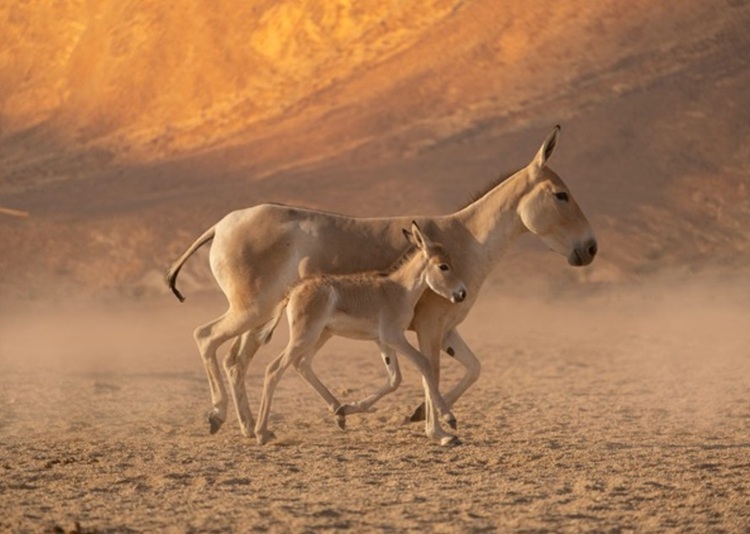
Riyadh : Prince Mohammed bin Salman Royal Reserve announces the birth of the first onager born and bred on Saudi Arabian soil in over 100 years, the return of an animal celebrated in the poetry of pre-Islamic and early Islamic Arabia, and absent from its deserts for over a century. Today, fewer than 600 Persian onager remain in the wild, the species was uplisted to Critically Endangered by the IUCN in 2025.
The male foal was born in June 2025 as part of the Reserve’s ReWildArabia programme, which is reintroducing 23 historically occurring native species to their former range. With a survival rate of just 50% in onager foals, the most critical part of an onager’s life is the first year. The birth is announced now that the foal has successfully navigated these critical first 12 months. Additionally, two mares are pregnant and due this winter. This birth and these pregnancies are a key indicator of conservation success, particularly significant at a time when the IUCN has projected a 90% decrease in the onager population by 2050.
Revered in the poetry of pre-Islamic and early Islamic Arabia, appearing in over 80 poems of the time, the onager was celebrated not as prey or as a beast of burden but as the embodiment of something untameable. Dhū al-Rummah (c. 696–735), regarded as the last true poet of the desert Bedouin tradition and the major representative of nature in classical Arabic poetry, describes how the onager eludes a hunter in his celebrated 126-verse Bā’iyya, “Off they sped. They pounded the foothill so vigorously, that the stones of the rocky terrain were almost set ablaze.” (The onager tableaus as translated by H. Dirbas in his article From Lostness to Salvation: Nature in Ḏū al-Rumma’s Desert Journey). In a world of camels and horses broken to human will, the onager answers to the desert alone.
“Through ReWild Arabia, we are bringing back a species that defined this landscape for millennia. The birth of the first onager foal bred on Saudi soil in over a century marks more than a conservation milestone. Immortalised in the verses of Arabia’s earliest poets as the spirit of the open sands, it signals the return of a symbol of freedom, endurance, and the wild heart of the desert,” said Andrew Zaloumis, CEO, Prince Mohammed bin Salman Royal Reserve.
he birth follows the historic reintroduction of the onager to the Kingdom from Jordan in April 2024. In partnership with the Royal Society for the Conservation of Nature, seven onager, five females and two males, travelled 935km overland from Jordan’s Shaumari Wildlife Reserve to the Reserve. A female foal, bred in Jordan, was born shortly after arrival. Two unsuccessful births followed, including the loss of a mare, a harsh reminder of the realities of rewilding. After eleven months of gestation, a newborn onager must find the strength to stand and nurse within 15-20 minutes of birth to obtain the colostrum essential for survival. Today, the Reserve’s herd comprises five females and three males, including sub-adults, and is the only onager population in Saudi Arabia.
Nasser Ashour, Animal Keeper Team Leader, born and raised in the Reserve, working with the onager said, “Seeing a new onager born and flourish is very special and shows that the conservation work here is making a real difference. Working with them every day has taught me so much about their behaviour and needs. Knowing this is the only population in Saudi Arabia makes it a great responsibility, but also a privilege to help protect such a rare species.”
The onager is a subspecies of the Asiatic wild ass, one of the oldest members of the equid family, older than the horse and zebra, dating back four million years. The onager species has five subspecies, including the Syrian wild ass, which once roamed the Arabian Peninsula in herds of up to one hundred. Hunting and habitat loss drove the Syrian wild ass to extinction. The last wild individual was shot in Iraq in the early 1920s, and the last captive animal died in Vienna Zoo in 1927. Its closest living relative is the Persian onager.
The Reserve is working to build a viable meta-population as part of its ReWildArabia programme, an ambitious rewilding initiative approved by the Reserve’s Board, chaired by HRH Crown Prince Mohammed bin Salman Al Saud. Fourteen of the twenty-three historically occurring species have been reintroduced. Six of these species have already successfully bred, Nubian ibex, Arabian oryx, Mountain gazelle, Sand gazelle, Arabian hare and onager. The Reserve is now focused on growing its onager herd’s gene pool. A new mare is currently in quarantine, waiting to join the herd from Jordan later this year with the goal of establishing two separate breeding herds to optimise long term viability, diversity, and resilience.
The program reflects a conservation vision without borders, developing national and regional partnerships essential to delivering holistic conservation solutions. The Reserve works closely with other conservation organisations including the National Centre for Wildlife in Saudi Arabia, fellow Royal Reserves and academic institutions such as KAUST and the Royal Society for Conservation of Nature in Jordan to share information, publish research and ultimately to build resilient populations of native, endangered species, with the shared goal to ReWildArabia