


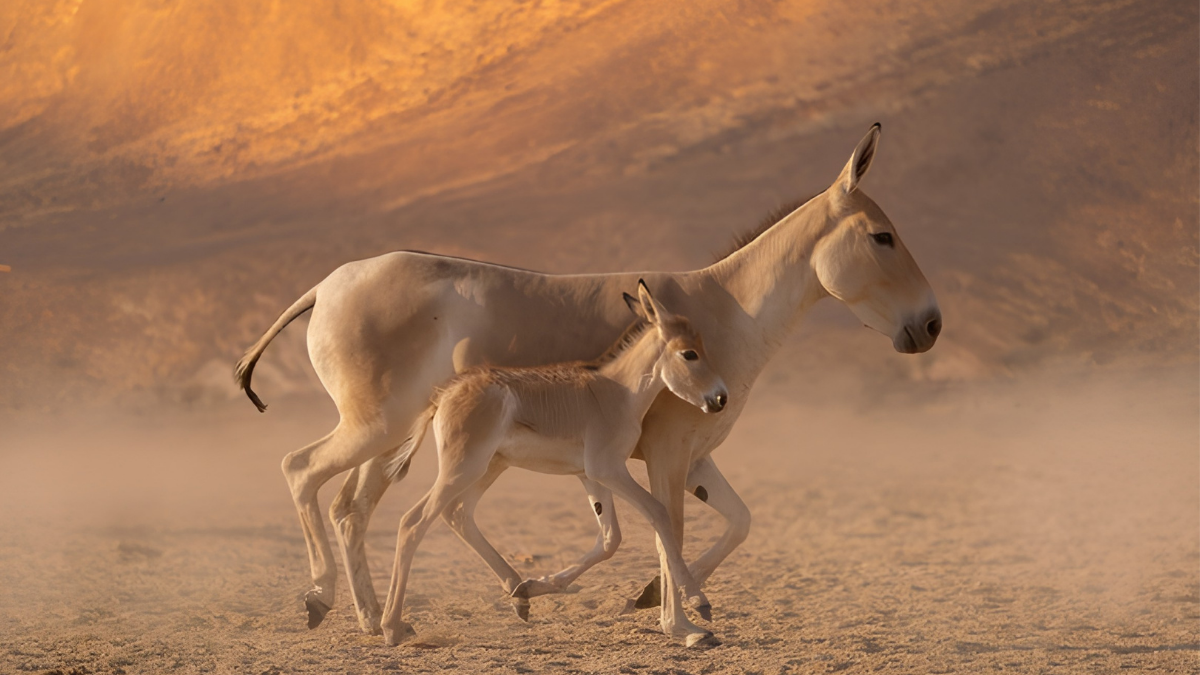
A Persian onager born in Saudi Arabia marks a significant milestone in the Kingdom’s efforts to restore endangered wildlife and revive its natural heritage. The male foal was born in June 2025 at the Prince Mohammed bin Salman Royal Reserve, representing the first successful birth and breeding of a Persian onager on Saudi Arabian soil in more than a century.
The announcement highlights the progress of ReWildArabia, an ambitious conservation programme designed to restore historically native species to their natural landscapes. It also draws attention to the challenges involved in rebuilding populations of rare animals whose numbers have declined because of hunting, habitat loss and other environmental pressures.
The foal’s survival through its critical first year makes the achievement particularly encouraging for conservation teams. With the Persian onager facing serious threats in the wild, the successful birth offers an opportunity to strengthen the species’ population in Saudi Arabia and support wider regional conservation efforts.
Beyond its scientific importance, the milestone reconnects the Kingdom with an animal that holds a place in Arabian history, literature and cultural memory.
A Historic Wildlife Conservation Achievement in Saudi Arabia
The Persian onager foal was born in June 2025 as part of the Prince Mohammed bin Salman Royal Reserve’s wildlife restoration efforts. The birth was officially announced only after the animal had successfully passed its first year, a period that can be especially challenging for young equids.
For conservation teams, a successful birth is only the beginning. Newborn animals must adapt to their environment, remain healthy and survive the early stages of development before they can contribute to the long-term recovery of a population.
The announcement therefore represents more than the arrival of a single foal. It demonstrates progress in establishing a breeding population of Persian onagers within a protected Saudi landscape.
The species remains highly vulnerable globally. The figures provided with the announcement estimate that approximately 600 Persian onagers remain in the wild. The International Union for Conservation of Nature (IUCN) has also been cited in connection with the species’ critically endangered status, highlighting the urgency of continued protection.
For Saudi Arabia, the achievement reflects a broader effort to restore native wildlife, strengthen protected areas and support biodiversity. For conservationists, it provides an opportunity to build on the initial success through careful population management, breeding and monitoring.
However, one successful birth cannot by itself secure the species’ future. Long-term progress will depend on the health of the population, genetic diversity, habitat conditions and continued cooperation among conservation organisations.
What Is a Persian Onager?
The Persian onager is a subspecies of the Asiatic wild ass, a wild equid adapted to the challenging environments of parts of western and central Asia. It is related to other members of the horse family, including horses, zebras and other wild asses, but has its own distinctive ecological characteristics.
Unlike domesticated horses and donkeys, onagers remain wild animals. Their survival depends on suitable habitat, access to food and water, and protection from threats that can disrupt their populations.
Persian onagers are associated with open landscapes and arid environments. Their ability to move across large areas helps them navigate habitats where resources can be unevenly distributed. Like other wild equids, they rely on their physical adaptations and behaviour to survive in demanding conditions.
Historically, wild asses and related equids occupied wider areas across the Middle East and neighbouring regions. Over time, hunting, habitat changes and human pressures contributed to declines in several populations.
The Syrian wild ass, a different wild ass subspecies, disappeared from the wild in the early twentieth century. Its extinction illustrates the risks facing species when populations become too small and conservation action comes too late.
The Persian onager’s current situation highlights why protecting remaining populations and carefully managing breeding programmes are important. Each successful birth can contribute to the establishment of a viable population, provided that conservation teams can maintain appropriate genetic diversity and suitable living conditions.
Why Is the Birth of a Persian Onager So Significant?
The successful birth and survival of the foal represent an important step in Saudi Arabia’s wildlife restoration efforts. Breeding rare animals in protected environments requires specialist knowledge, appropriate facilities, animal welfare planning and long-term monitoring.
The early stages of an onager’s life can be particularly demanding. The supplied conservation information notes that foals face significant mortality risks during their first year. Newborns must also adapt quickly after birth, including standing and nursing within a short period to receive essential nourishment.
The Persian onager’s gestation period is approximately 11 months. This lengthy reproductive cycle means that breeding programmes must be planned carefully, and the results of interventions may take time to become apparent.
For conservation teams, each pregnancy involves monitoring the health of the mare, preparing for birth and ensuring that the newborn receives appropriate care. After delivery, the foal’s development and survival must be assessed before the birth can be considered a meaningful contribution to population recovery.
The Reserve’s announcement also indicated that two additional mares were pregnant, with births expected later in the year. Such developments could support the population’s growth, although successful outcomes depend on the health of the animals and the progress of each pregnancy.
The achievement is therefore significant not simply because a rare animal was born, but because it demonstrates that the breeding programme is progressing. Continued monitoring will be essential to understand whether this initial success can develop into a stable, self-sustaining population.
Bringing a Lost Species Back to Arabia
The Persian onager’s return to Saudi Arabia followed a wildlife transfer from Jordan in 2024. Seven animals, comprising five females and two males, were transported from the Shaumari Wildlife Reserve to the Prince Mohammed bin Salman Royal Reserve.
The transfer covered approximately 935 kilometres and represented an important step in establishing a breeding population within Saudi Arabia.
Moving wild animals between protected areas requires extensive coordination. Conservation teams must consider animal health, transport conditions, handling procedures and the suitability of the receiving environment. Such operations also depend on collaboration between the organisations responsible for the animals at both locations.
The initial establishment of a new population can involve setbacks. The information provided about the programme notes that earlier breeding attempts encountered challenges, including unsuccessful births and the loss of a mare.
These difficulties underline the uncertainty involved in wildlife conservation. Even when suitable facilities and experienced teams are available, reproduction and survival cannot be guaranteed.
Nevertheless, conservation programmes often require sustained effort over several years. Teams may need to adjust breeding arrangements, monitor individual animals and improve their understanding of how the population responds to its environment.
The Reserve’s onager population was reported to include five females and three males, including young sub-adults. This reported composition reflects the continuing effort to establish a population capable of reproducing over time.
The arrival of animals from Jordan also demonstrates the importance of regional conservation cooperation. Protected areas can support one another by sharing expertise and, where appropriate, facilitating carefully managed transfers that strengthen threatened populations.
The Role of the Prince Mohammed bin Salman Royal Reserve
The Prince Mohammed bin Salman Royal Reserve is central to this conservation initiative. Through its wildlife restoration work, the Reserve aims to support the recovery of species that historically formed part of the Arabian landscape.
Reintroducing a species involves much more than releasing animals into a protected area. Conservation teams must assess habitat suitability, available resources, animal welfare requirements and potential risks before establishing a population.
Monitoring continues after animals arrive. Teams need to understand how individuals adapt, whether breeding is successful and what measures may be required to support long-term survival.
For a species such as the Persian onager, breeding management is particularly important because a small population can be vulnerable to genetic problems and changes in the balance between males and females.
The Reserve’s work therefore involves both immediate animal care and longer-term ecological planning. Successful breeding can help build the population, but it must be supported by an environment that allows the animals to remain healthy and reproduce in the future.
The foal’s survival through its first year provides an encouraging result within this broader process. Continued progress will depend on maintaining appropriate conditions and learning from the successes and challenges encountered along the way.
A Symbol of Arabia’s Wild Heritage
The Persian onager is significant not only as a rare wild animal but also as part of the region’s cultural memory.
Wild asses and other desert animals appeared in classical Arabic poetry, where writers used descriptions of their speed, endurance and independence to evoke the natural world. Such imagery helped connect wildlife with the wider landscapes, traditions and experiences of life in Arabia.
Unlike domesticated animals such as camels and horses, the wild ass represented an animal that remained independent of human control. Its ability to survive in difficult environments made it a compelling subject for descriptions of strength, movement and resilience.
The supplied information highlights the onager’s presence in more than 80 classical Arabic poems. This connection gives the conservation programme a cultural dimension alongside its ecological goals.
The animal’s return can therefore be understood as an effort to restore part of the region’s natural heritage. Protecting wildlife can preserve not only biodiversity but also the connections between species, landscapes, historical accounts and cultural traditions.
Andrew Zaloumis, CEO of the Prince Mohammed bin Salman Royal Reserve, has described the birth as a conservation achievement linked to the revival of an important symbol of Arabia’s natural heritage.
For visitors and local communities, the story offers a reminder that the Kingdom’s landscapes contain histories extending beyond archaeological monuments and historic settlements. Native wildlife is also part of that heritage, and its protection can contribute to a more complete understanding of the region.
What Is Saudi Arabia’s ReWildArabia Programme?
The Persian onager’s return forms part of ReWildArabia, a conservation programme intended to restore historically native species to Saudi Arabia’s landscapes.
According to the supplied information, the programme aims to reintroduce 23 species. Fourteen species had reportedly been reintroduced at the time described, including the Arabian oryx, mountain gazelle, sand gazelle, Nubian ibex, Arabian hare and Persian onager.
The programme’s wider objective is to rebuild wildlife populations and support the ecological relationships that have been disrupted by species declines.
Reintroductions can contribute to conservation when animals are placed in suitable habitats and receive the protection required to survive. However, each species has different ecological needs, so planning must be tailored to its behaviour, diet, reproduction and environmental requirements.
The programme’s reported progress includes successful breeding by six of the reintroduced species. This indicates that some populations have progressed beyond the initial release stage and are reproducing within the Reserve.
For the Persian onager, successful breeding represents an important step towards establishing a population that can persist over time. Conservation teams are also working to improve genetic diversity, including plans to introduce an additional mare from Jordan and establish two separate breeding herds.
Managing genetic diversity is particularly important when a population begins with relatively few individuals. Carefully planned breeding can help reduce the risks associated with a limited gene pool and improve the population’s prospects over successive generations.
ReWildArabia’s progress will ultimately be measured not only by the number of species reintroduced, but also by their health, reproduction and ability to survive over the long term.
Why Conservation Partnerships Matter
Wildlife restoration rarely succeeds through the work of one organisation alone. It requires cooperation among protected areas, wildlife authorities, researchers, veterinarians and other conservation specialists.
The Persian onager transfer from Jordan demonstrates the practical importance of these relationships. Moving animals between reserves requires coordination, shared knowledge and appropriate safeguards to protect the animals throughout the process.
Research and monitoring also help conservation teams understand the needs of individual species. Information about health, breeding outcomes, behaviour and habitat use can inform decisions about population management.
Academic institutions and scientific partners can contribute expertise, while wildlife organisations help coordinate conservation priorities and management practices.
Regional cooperation is particularly valuable for endangered species because their populations may be concentrated in a small number of locations. Collaboration can create opportunities to strengthen genetic diversity and share experience between conservation programmes.
For the Persian onager, the partnership between Jordanian and Saudi conservation efforts has helped establish the foundation for a new population in the Kingdom.
Continued collaboration will be important as the programme develops. Future decisions about breeding, animal transfers and habitat management will need to be based on the population’s progress and the long-term requirements of the species.
What This Means for Wildlife Conservation in Saudi Arabia
The Persian onager’s successful birth highlights the growing role of wildlife restoration within Saudi Arabia’s broader environmental initiatives.
Reintroducing native species can help restore ecological relationships and reconnect protected landscapes with their historical wildlife. Such efforts also create opportunities to expand scientific research, improve conservation expertise and strengthen regional cooperation.
However, conservation outcomes require patience. Animals need suitable habitats, protection and sufficient opportunities to reproduce. Populations that begin with a small number of individuals can remain vulnerable even after successful births.
Monitoring will therefore remain essential to determine whether the Persian onager population grows, whether additional breeding attempts succeed and whether genetic diversity can be maintained.
The programme also illustrates why conservation success should be assessed over several years rather than through a single milestone. A birth can provide valuable evidence of progress, but a stable population requires multiple generations and consistent management.
For Saudi Arabia, these efforts offer an opportunity to protect species associated with its natural and cultural heritage while contributing to wider regional conservation goals.
Frequently Asked Questions
What is a Persian onager?
The Persian onager is a subspecies of the Asiatic wild ass. It is a wild equid associated with arid landscapes and is threatened by factors including habitat loss and human pressures.
Where was the Persian onager foal born in Saudi Arabia?
The male foal was born at the Prince Mohammed bin Salman Royal Reserve in June 2025 as part of the Reserve’s wildlife restoration programme.
Why is the birth considered historic?
The birth was reported as the first successful Persian onager birth and breeding on Saudi Arabian soil in more than a century. The foal’s survival through its first year made the announcement particularly significant.
How did Persian onagers return to Saudi Arabia?
Seven animals were transferred from Jordan’s Shaumari Wildlife Reserve in 2024. The transfer established the foundation for a breeding population in the Saudi reserve.
What is ReWildArabia?
ReWildArabia is a conservation programme aimed at restoring historically native wildlife species to Saudi Arabia’s landscapes through reintroduction and related conservation efforts.
Why is genetic diversity important for the onager population?
Genetic diversity helps reduce risks associated with a small breeding population. Careful population management and appropriate breeding arrangements can support the long-term health and resilience of the species.
Final Thoughts: A New Chapter for Arabia’s Wildlife
The birth of a Persian onager in Saudi Arabia after more than a century represents an important milestone in the Kingdom’s wildlife conservation efforts. It highlights the dedication required to restore threatened species and establish populations capable of surviving into the future.
From the original transfer of animals from Jordan to the successful birth and survival of the foal, the programme demonstrates the importance of sustained care, scientific monitoring and regional cooperation.
The achievement also reconnects the Kingdom with a species that forms part of Arabia’s natural and cultural history. Yet the long-term outlook will depend on continued breeding success, genetic diversity, habitat protection and careful management.
As ReWildArabia continues its work, the Persian onager’s return provides a meaningful example of how conservation programmes can help restore native wildlife and protect biodiversity.
Follow Eat’N Stays for more updates on wildlife conservation, environmental initiatives, travel and hospitality developments across Saudi Arabia and the wider region.