



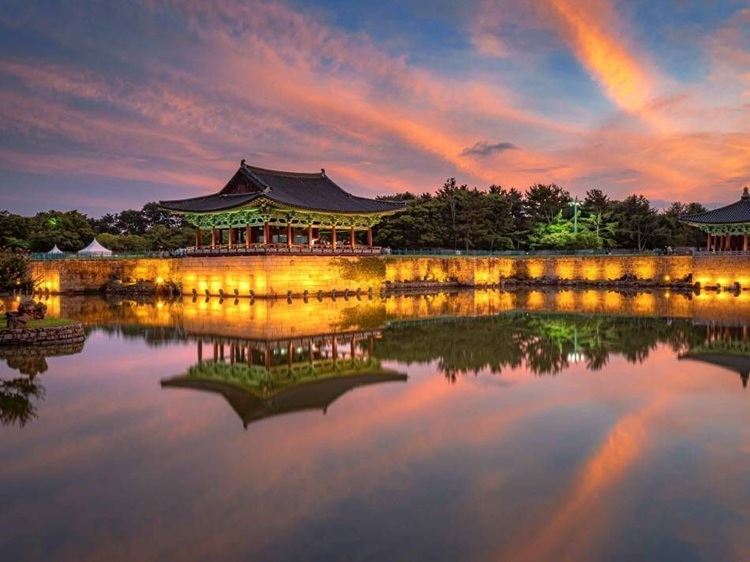
Korea is a unique country where the past and the present blend harmoniously together, a testament to its 5,000-year history. The country’s colorful four seasons and rich cultural heritages present an unforgettable experience to business travelers and tourists alike.
In today’s world, Korea’s diverse culture—spanning from popular culture such as K-pop, films, and dramas to elements of cultural identity like arts, Hangeul, and Hanbok—is gaining global attention. Read on to discover Korea’s distinctive charms and Gyeongju, a city of a thousand years and the host city of APEC 2025 Korea.
Korean Art: The Beauty of Naturalness
From the Paleolithic period onward, the Korean Peninsula has been continuously inhabited, and through antiquity, the medieval period, and the early modern era, Korea developed a distinctive culture and emerged as a major civilization in East Asia.
While sustaining a shared universality of East Asian culture, the essence of Korean art is defined by its distinctive and original beauty. Across all genres and periods, two defining national qualities emerge as a continuous thread: an understated, nature-attuned beauty that privileges the natural over the artificial, and a warm humanism in which the human touch is ever present.
A man of letters from the Goryeo period encapsulated this Korean aesthetic in a refined dictum: “humble yet not undignified, and splendid yet not extravagant.”
A Short History of Korean Art
Art and history—a short journey in search of beauty carrying the spirit of its time
By National Museum of Korea, Gyeongju National Museum
[Foreword] You Hong-June (Director of National Museum of Korea) This booklet is intended for first-time visitors to Korea and for international readers interested in Korean culture. Through works of art, it introduces the nation’s history and cultural traditions. Accompanied by representative images from each period and genre, this booklet is concisely written and elegantly designed so that international readers can readily engage with the trajectory of Korean history and appreciate the essence of its aesthetics.
Gyeongju Reimagined: From Silla’s Legacy to Modern Trends
Often called “Museum without Walls,” Gyeongju is a living testament to Korea’s rich history, offering visitors a chance to explore temples, pagodas, palaces, royal tombs, and much more. It boasts several UNESCO World Heritage sites, including Bulguksa Temple, built with excellent architectural methods; Seokguram Grotto, the world’s only granite-carved grotto; Gyeongju Historic Area; and Yangdong Village, offering visitors a journey through time.
Currently, Gyeongju is gaining worldwide attention as the host city of the APEC (Asia-Pacific Economic Cooperation) 2025 Economic Leaders’ Meeting. Explore the multifaceted city of Gyeongju, where the past and the present coexist!
Must-Visit Attractions