


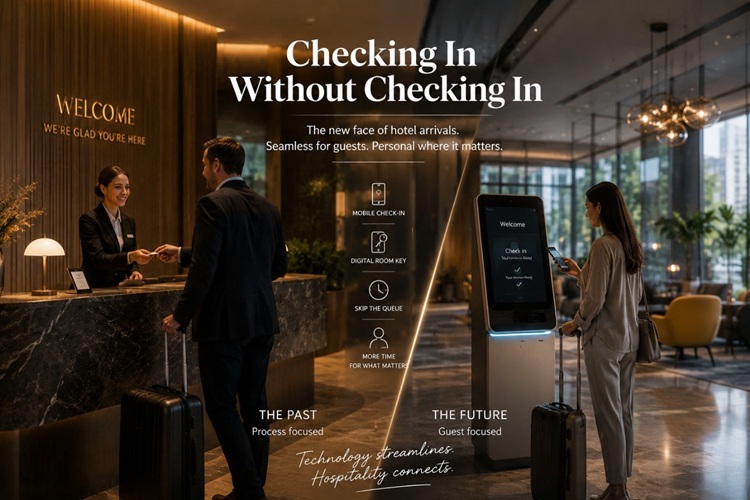
As hotels embrace seamless technology, can hospitality remain just as personal?
By Fayez Saad
Imagine arriving at your hotel after a long flight. Instead of walking towards the reception desk, you receive a notification on your phone. Your room is ready. A digital key appears in the hotel’s app, allowing you to head straight to your room without waiting in line, filling out paperwork, or exchanging a single word with another person. Within minutes, you’re unpacking your suitcase.
For many travellers, that sounds like progress. But it also raises an interesting question: if checking into a hotel no longer requires speaking to another person, has the experience improved, or have we quietly removed one of hospitality’s most defining moments?
For generations, the reception desk has been one of the most recognisable features of a hotel. It was where journeys officially began. Guests arrived tired from long-haul flights, excited for holidays, or focused on the business meetings ahead, and someone was there to greet them. The reception desk wasn’t simply a place to collect a room key; it was where first impressions were made, questions were answered, and the tone for the entire stay was set.
Today, that familiar ritual is beginning to change. Hotels across the world are embracing mobile check-ins, digital room keys, self-service kiosks, facial recognition, and AI-powered guest services. What once required several minutes at the front desk can now happen before a guest even walks through the entrance. And, if we’re honest, most people won’t miss the process itself.
Nobody enjoys standing in a queue after an overnight flight or waiting while documents are verified. The reception desk was never the reason people travelled; it was simply the gateway to the experience. Technology hasn’t removed the parts guests loved; it has largely removed the parts they tolerated.
That is where the conversation becomes more interesting. If technology takes over the process, what happens to the welcome? The reception desk represented far more than administration. It was where anniversaries were acknowledged, local recommendations were shared, nervous first-time travellers were reassured, and returning guests were welcomed back by name. Those moments were never listed on a booking confirmation, yet they often became the memories guests carried home. They weren’t part of the check-in process; they were hospitality itself.
Perhaps, then, we’ve been looking at the wrong thing. The future of hospitality isn’t about removing people; it is about removing the barriers that prevent people from doing what they do best. Walk into many modern luxury hotels today and you’ll notice that receptionists are no longer confined behind a counter. Instead, they are greeting guests in the lobby, escorting arrivals to comfortable seating areas, offering personalised recommendations, or resolving issues before they become complaints. Technology hasn’t eliminated the receptionist; it has allowed them to become a host once again.
This shift highlights something technology still struggles to replicate. Systems can verify identities, process payments, issue digital keys, and manage reservations with remarkable efficiency. What they cannot do is recognise the exhaustion on a traveller’s face after a delayed flight, sense when a guest needs reassurance rather than information, or turn an ordinary interaction into a memorable one. Hospitality has always been built on empathy, and while technology continues to transform operations, empathy remains a distinctly human advantage.
In many ways, the reception desk has never been a permanent fixture; it has simply evolved with every generation of travel. Decades ago, it was a place where handwritten registers were filled, room keys were stored behind wooden cabinets, and local knowledge existed only in the minds of experienced receptionists. Computers changed that. Online bookings changed it again. Mobile technology is simply the next chapter in a transformation that has been unfolding for years.
What feels revolutionary today may soon become routine. The question is not whether hotels will continue to evolve, but whether the industry’s defining characteristic- its ability to make people feel genuinely welcome- can evolve alongside it.
As Saudi Arabia accelerates its hospitality ambitions under Vision 2030, this balance between innovation and human connection will become increasingly important. The Kingdom’s next generation of hotels will undoubtedly embrace digital-first guest journeys, smart rooms, AI-assisted concierge services, and seamless mobile experiences.
Yet their long-term success will depend not only on how efficiently they adopt technology, but on how effectively they preserve the warmth and authenticity that travellers continue to value. In many ways, Saudi Arabia has the opportunity to demonstrate that digital hospitality doesn’t have to feel distant; it can be both effortless and deeply personal.
The reception desk may eventually disappear from hotel lobbies. Plastic key cards will give way to smartphones, paperwork will become digital, and check-in may become almost invisible. But if that future arrives, it shouldn’t be remembered as the moment hospitality became less personal. It should be remembered as the moment hospitality finally stepped out from behind the desk and stood beside the guest.
Because the reception desk was never the heart of a hotel.
The people were.

Ahmed Abdul Wasey
Managing Editor, Eat ‘N Stays
Ahmed Abdul Wasey is the Managing Editor in Eat ‘N Stays, overseeing all editorial coverage of travel, hospitality, and food across Saudi Arabia and the wider Gulf region. He sets the publication’s editorial direction and reviews coverage across hotels, restaurants, tourism, cruise, and industry news before it publishes.
Have a story tip, correction, or question about our coverage? Reach Ahmed directly at pr@eatnstays.com.