



By Fayez Saad
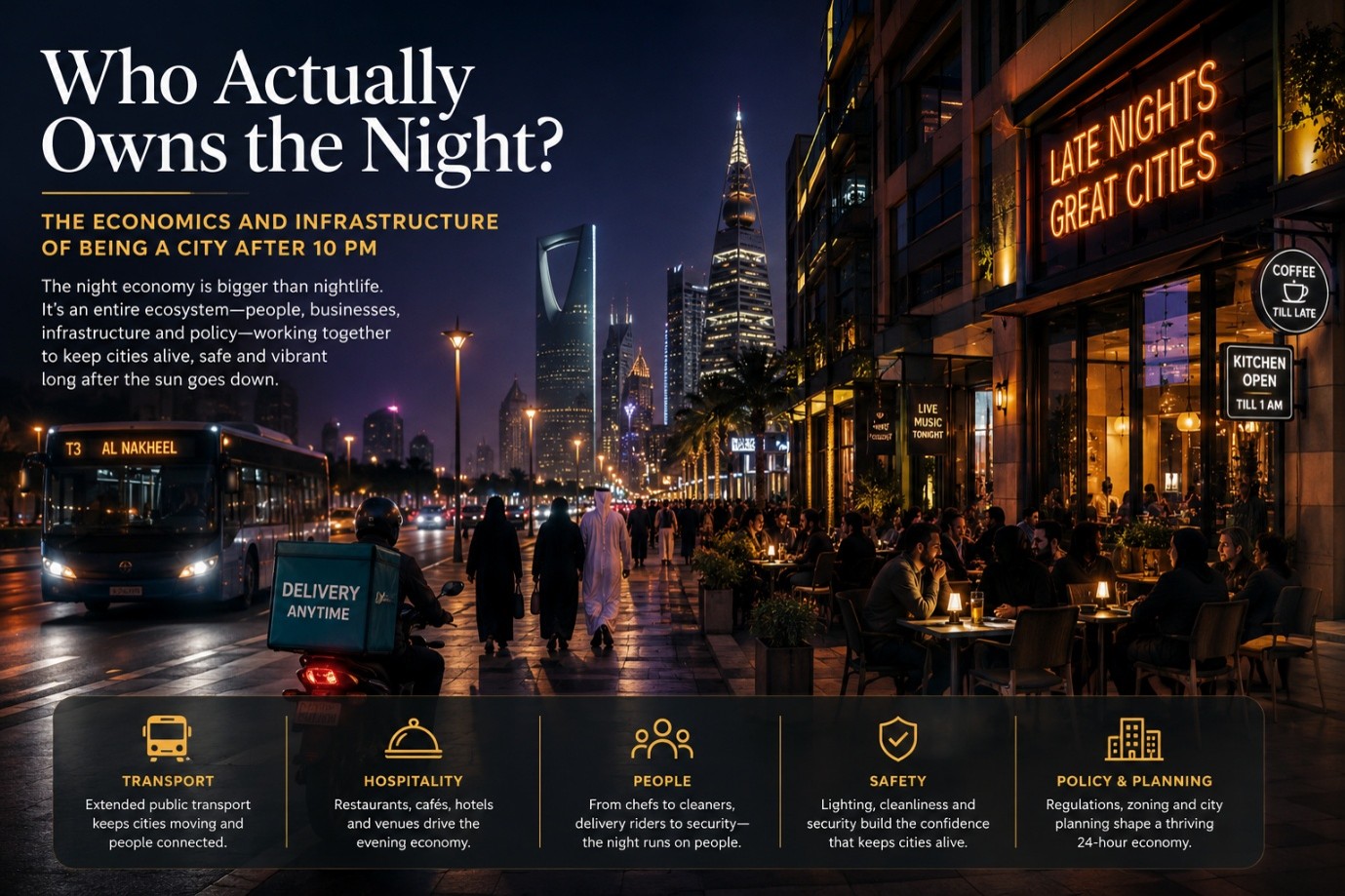
The economics and infrastructure of becoming a city after 10 pm
At 10 pm, something interesting happens in many cities. Offices empty, traffic changes, restaurants fill up and streets that felt ordinary a few hours earlier begin to take on another identity. For some people, the working day is finally over. For others, it is only beginning. A chef is starting a shift, a hotel receptionist is welcoming a late arrival, a delivery rider is making another trip across the city and a group of friends is deciding where to spend the next few hours.
We tend to think of the night as a period of leisure. But a city’s life after dark is much bigger than nightlife. It is an economy, a workforce and an infrastructure challenge. Restaurants, cafes, hotels, entertainment venues, retailers, transport operators and delivery platforms all depend on people being willing and able to move through the city at night. The question, therefore, isn’t simply whether a city has places that stay open late. It is whether the city itself is equipped to support them.
That distinction matters because a restaurant can stay open until 2 am, but that doesn’t mean a city is genuinely operating at 2 am. If employees cannot get home safely, public transport has stopped running, parking becomes difficult, streets are poorly lit or essential services have disappeared, the night economy has a ceiling. Hospitality businesses can extend their opening hours, but they cannot build the entire ecosystem around them. A 24- hour economy needs more than 24- hour businesses.
This is becoming particularly relevant in Saudi Arabia. The kingdom’s changing tourism and entertainment landscape is creating more reasons for people to spend time outside their homes after traditional working hours. Riyadh Season has demonstrated the scale of demand for evening entertainment, attracting 20 million visitors in its 2024-25 edition, while the General Entertainment Authority recorded 12.6 million visitors across 468 entertainment events in 116 cities during Q3 2025 alone. The country’s tourism sector is also becoming a much larger economic engine, with tourism spending reaching a record SAR 304 billion in 2025.
But perhaps the most revealing example of Saudi Arabia’s relationship with the night comes from somewhere people might not immediately expect: Ramadan. During the holy month, the kingdom effectively demonstrates what happens when an entire economy changes its operating rhythm. Commercial activity shifts towards the evening; restaurants and cafes extend their hours and shopping and social activity can continue deep into the night. In 2026, Arab news described the period as a near reversal of the usual daily clock, with retail, restaurants, cafes and food delivery seeing significant activity after evening prayers.
That tells us something important. The demand for a nighttime economy already exists. What changes is whether cities are designed to support it consistently.
Transport is one of the clearest examples. During Ramadan 2025, the Riyadh metro operated until 2 am on most days, and Riyadh buses operated until 3 am, specifically adapting public transport to the city’s changed rhythms. It is a relatively simple adjustment, but it illustrates a much larger principle: when people live differently at night, the infrastructure around them has to change too.
And transport is only one part of the equation. Someone has to clean the restaurant after closing. Someone has to deliver food. Someone has to maintain the hotel. Someone has to provide security. Someone has to collect waste. Someone has to keep roads, public spaces and utilities functioning. The night economy creates an entire workforce that most customers barely notice. The city may be asleep for some people, but it is still working for others.
There is also a hospitality opportunity hiding inside this shift. If people are spending more of their leisure time after dark, the experience of a city at night becomes part of its tourism proposition. A destination isn’t only its museums, hotels and landmarks during daylight hours. It is also its restaurants at midnight, its waterfronts after sunset, its late-night cafés, its entertainment districts and the feeling of being able to safely explore somewhere when most of the world has gone quiet. Saudi Arabia’s growing hospitality and entertainment infrastructure is already moving in this direction, with destinations such as The Groves in Riyadh combining dining, entertainment and lifestyle experiences as part of a broader destination offering.
But there is a bigger question underneath all of this: who actually owns the night? Is it the restaurant that stays open until 2 AM? The hotel that accommodates the late traveller? The government that regulates operating hours? The transport network that gets workers home? Or the people who decide that 10 PM is when their day finally begins?
The answer is probably all of them. A successful night-time economy cannot belong to one industry because it doesn’t operate within one industry. Hospitality depends on transport. Entertainment depends on hospitality. Retail depends on footfall. Footfall depends on accessibility. Accessibility depends on infrastructure. And all of it ultimately depends on whether people feel comfortable spending time in the city after dark.
Perhaps this is the next stage of the conversation around modern cities. We have spent decades designing urban spaces around the 9-to-5 city. But as tourism, entertainment, dining and leisure become increasingly important to urban economies, the city after 10 PM deserves just as much thought as the city at 10 AM.
The future of the night may not belong to the city that stays open the latest.
It may belong to the city that understands how to keep working when everyone else’s day is supposed to be over.