

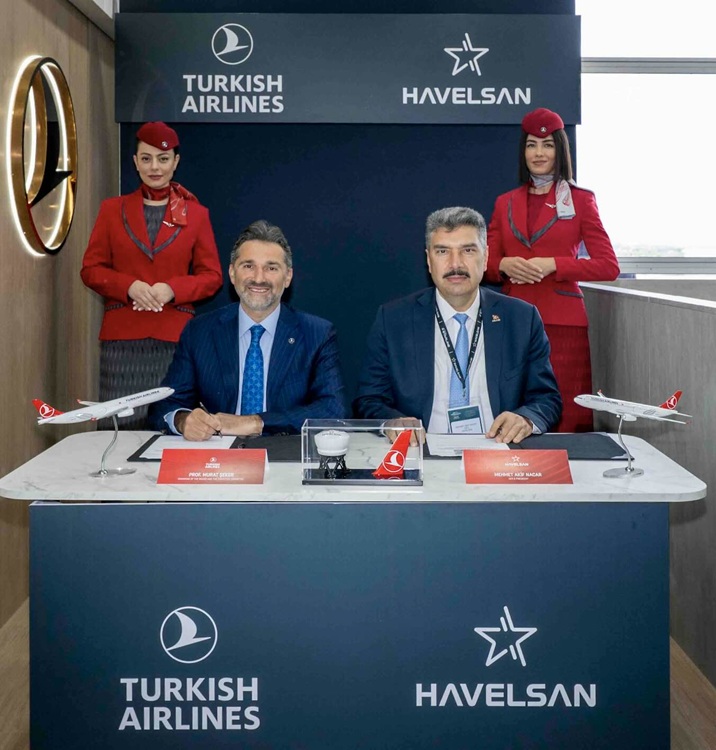
Turkish Airlines, the airline that flies to more countries than any other airline, aiming to grow its fleet to over 800 aircraft by 2033 in line with its strategic growth targets, signed an agreement with HAVELSAN for the supply of a total of 12 new simulators, comprising 8 Full Flight Simulators (FFS) and 4 Flight Training Devices (FTD).
The agreement will support the expansion of training capacity at Turkish Airlines’ simulator hangars, whose groundbreaking took place in January 2026 with the first phase planned to become operational in 2027, as well as at the new Flight Training Center, which is set to be completed in 2028.
Developed and manufactured entirely in Türkiye, the simulators will be integrated into Turkish Airlines’ growing training infrastructure. This will support the development of advanced pilot training systems through domestic capabilities while making a significant contribution to strengthening competencies in the field of high technology.
Commenting on the agreement, Turkish Airlines Chairman of the Board and the Executive Committee Prof. Murat Şeker said: “With these new orders, by 2033 the Turkish Airlines Flight Training Center will become one of Europe’s largest flight training centers across three campuses, meeting the needs of Turkish Airlines while also providing training services for other airlines. We would like to thank HAVELSAN for its valuable contributions to this goal and for helping strengthen Türkiye’s domestic aviation ecosystem through advanced homegrown technologies.”
HAVELSAN General Manager Dr. Mehmet Akif Nacar added: “This agreement marks an important milestone as it represents our entry into the wide-body flight simulation field. We thank our long-standing business partner, our country’s flag-carrier Turkish Airlines for the trust it has placed in us, and we remain committed to our determination to provide high-quality, advanced technology-based simulation solutions in the field of pilot training.”
What the HAVELSAN simulators will add
Under the scope of the agreement, Turkish Airlines will take delivery of 8 Full Flight Simulators (FFS) and 4 Flight Training Devices (FTD). The airline is already actively using 3 Airbus A320NEO/CEO, 3 Boeing 737MAX, and 1 Boeing 737NG full flight simulators at its training centers, all manufactured by HAVELSAN and certified to EASA Level D standards. The new orders reflect the flag-carrier’s confidence in HAVELSAN’s simulator capabilities.
Turkish Airlines will continue to further advance its capabilities in pilot training with an advanced simulation infrastructure fully compliant with international civil aviation standards.
Strengthening Türkiye’s Aviation Training Infrastructure
The agreement between Turkish Airlines and HAVELSAN highlights the growing importance of advanced flight simulation in supporting the aviation industry’s long-term development. As airlines expand their fleets and introduce new aircraft, access to modern training facilities becomes increasingly important for preparing pilots to operate aircraft safely and efficiently. Flight simulators provide a controlled environment in which pilots can practise normal operations, respond to unexpected situations and develop the skills required for different phases of flight.
Full Flight Simulators are particularly valuable because they replicate aircraft operations through realistic cockpit systems, visual environments and motion capabilities. These facilities allow pilots to practise complex procedures without operating an actual aircraft, supporting recurrent training, proficiency assessments and emergency-response preparation. Flight Training Devices also contribute to pilot development by providing specialised environments for practising cockpit procedures and aircraft systems.
Supporting Turkish Airlines’ Long-Term Fleet Expansion
Turkish Airlines’ ambition to operate more than 800 aircraft by 2033 reflects its broader growth strategy and the need to expand supporting infrastructure alongside its fleet. Increasing simulator capacity can help the airline manage training requirements as its operations grow, while supporting the development of pilots across different aircraft types.
The planned expansion of its simulator hangars and the development of the new Flight Training Center will provide additional capacity for training activities in the coming years. With the first phase of the simulator hangars expected to become operational in 2027 and the new centre scheduled for completion in 2028, the airline is preparing its training infrastructure for future demand.
Beyond meeting its own requirements, Turkish Airlines also expects its training facilities to provide services to other airlines. This could strengthen its position in the aviation training market and create additional opportunities for collaboration across the industry.
Advancing Domestic Aviation Technology
HAVELSAN’s role in supplying the new simulators also underlines Türkiye’s focus on developing domestic capabilities in advanced aviation technologies. Designing and manufacturing simulation systems locally can support technical expertise, innovation and the growth of the country’s aerospace and defence technology ecosystem.
The agreement’s significance extends beyond the delivery of equipment. It represents a long-term partnership focused on building training capacity and developing sophisticated simulation solutions. As aviation technology evolves, continued investment in simulation can help training providers adapt to changing aircraft systems, operational requirements and international standards.
Together, Turkish Airlines and HAVELSAN are strengthening the infrastructure needed to support future aviation growth. Their collaboration demonstrates how investment in pilot training, advanced technology and local manufacturing can contribute to a more capable aviation ecosystem while preparing the airline for its ambitious fleet expansion plans through 2033.
Related Reading: Turkish Airlines Lays the Foundations for a New Investment Initiative Worth TRY 100 billion

Ahmed Abdul Wasey
Managing Editor, Eat ‘N Stays
Ahmed Abdul Wasey is the Managing Editor in Eat ‘N Stays, overseeing all editorial coverage of travel, hospitality, and food across Saudi Arabia and the wider Gulf region. He sets the publication’s editorial direction and reviews coverage across hotels, restaurants, tourism, cruise, and industry news before it publishes.
Have a story tip, correction, or question about our coverage? Reach Ahmed directly at pr@eatnstays.com.