



By Fayez Saad
For decades, Saudi Arabia’s tourism story was written on land.
Its vast deserts, ancient trade routes, UNESCO World Heritage Sites, and growing collection of luxury hotels shaped the way visitors experienced the Kingdom. From the dramatic rock formations of AlUla to the bustling streets of Jeddah and the modern skyline of Riyadh, Saudi Arabia has built its identity around destinations that invite travellers to explore what lies beyond the horizon.
Today, that horizon is beginning to shift.
Not towards another city.
Not towards another luxury resort.
But towards the sea.
Cruise tourism is emerging as one of the Kingdom’s most intriguing hospitality developments—not because Saudi Arabia suddenly discovered its coastline, but because it has begun to see its waters as an extension of the guest experience.
For years, the country’s coastline was viewed primarily through the lens of trade, industry, and commerce. Yet stretching along both the Red Sea and the Arabian Gulf lies one of the region’s most valuable tourism assets. The coastline has always been there. What has changed is the vision behind it.
Hospitality has always evolved alongside the way people choose to travel.
There was a time when travellers measured a holiday by the hotel they stayed in. Today, experiences carry equal, if not greater, value. Visitors want journeys that feel immersive, flexible and memorable. They want destinations that tell stories rather than simply provide accommodation.
Cruise tourism naturally fits into that shift.
Unlike a traditional holiday centred around a single destination, a cruise transforms the journey itself into part of the experience. Each port introduces a new chapter, while the ship becomes a moving extension of the hospitality ecosystem—combining accommodation, dining, entertainment, wellness and service into one seamless guest experience.
This is where Saudi Arabia’s emerging cruise story becomes particularly compelling.
The Kingdom isn’t entering the cruise industry with the intention of replicating the Caribbean or the Mediterranean. Those markets were built over decades, shaped by entirely different geographies, tourism histories and travel cultures.
Saudi Arabia has the opportunity to create something distinctly its own.
The red sea offers a landscape unlike almost anywhere else in the world. Pristine islands, vibrant coral reefs, untouched coastlines, rich marine biodiversity and centuries of maritime history provide experiences that extend far beyond the sun-and-sea luxury developments of the Red Sea Project and the growing appeal of Yanbu and other coastal cities. Cruise itineraries have the potential to showcase a side of Saudi Arabia that many international travellers have yet to discover.
But perhaps the most interesting aspect of this transformation isn’t the ships themselves.
It’s what happens when they arrive.
Every cruise passenger stepping ashore becomes part of a much larger hospitality story. They visit cafés tucked into historic districts, dine at local restaurants, browse artisan markets, book cultural excursions, explore museums and interact with local communities. The economic impact stretches well beyond the port, creating opportunities for hotels, retailers, transport providers, tour operators and countless small businesses that contribute to the overall visitor experience.
In many ways, cruise tourism acts as a connector.
It brings together sectors of the hospitality industry that often operate independently and places them into a single, continuous guest journey. From the moment a traveller boards the ship to the final excursion before departure, every interaction becomes an opportunity to shape perceptions of the destination.
This aligns closely with Saudi Arabia’s broader tourism ambitions.
As Vision 2030 continues to diversify the Kingdom’s economy, tourism is no longer measured solely by visitor numbers. Increasingly, the focus is on creating experiences that encourage travellers to stay longer, explore deeper and return. Cruise tourism complements that ambition by introducing visitors to multiple destinations in a single trip, often inspiring future visits centred around places they first encountered during a port call.
Yet perhaps the greatest opportunity lies in something less tangible.
Cruise tourism invites Saudi Arabia to tell its story differently.
For many international travellers, the kingdom has traditionally been associated with deserts, heritage sites and religious tourism. Cruise itineraries offer another perspective, one shaped by coastal culture, marine ecosystems, waterfront cities and contemporary hospitality. They broaden the narrative without replacing it, revealing dimensions of the country that have often remained outside the global conversation.
Hospitality has always been about helping people discover places in meaningful ways.
Sometimes that begins with a hotel lobby.
Sometimes it begins with a restaurant overlooking a historic street.
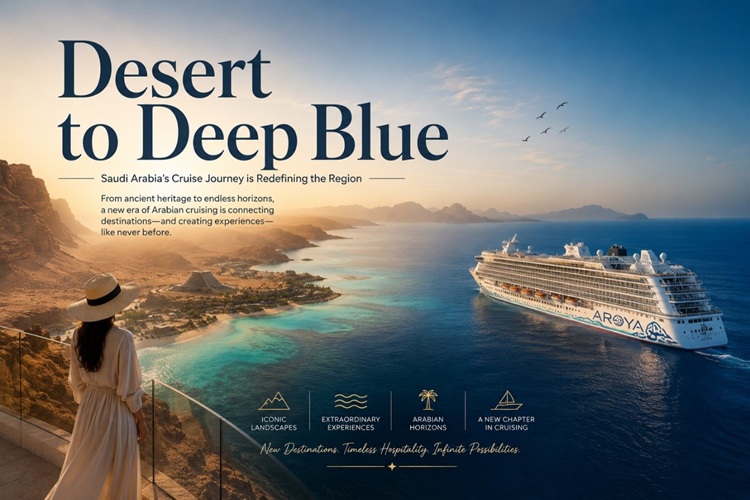
Increasingly, it may begin from the deck of a ship approaching the Saudi coastline for the very first time.
Perhaps that’s why Saudi Arabia’s emerging cruise story isn’t really about cruising at all.
It’s about a hospitality industry recognising that great destinations aren’t defined only by where they stand.
Sometimes, they’re defined by how they’re discovered.