



By Fayez Saad
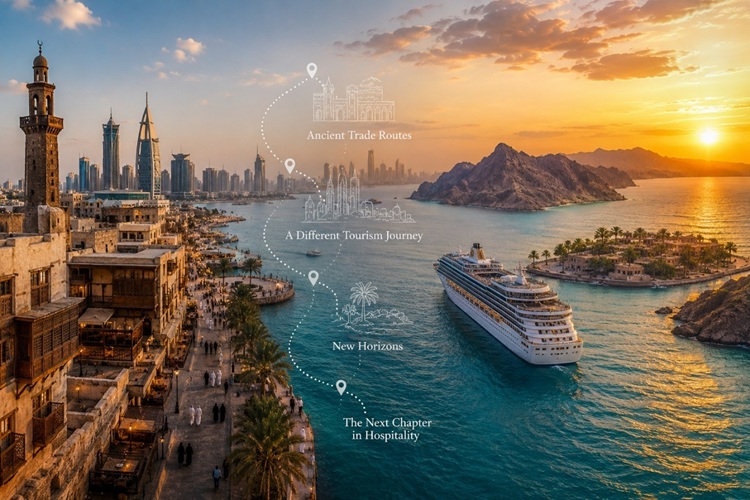
Stand on the Corniche in Jeddah as the sun begins to set, and it’s easy to forget that you’re looking at one of the world’s busiest and most historically significant waterways.
Walk along Dubai Marina, and luxury yachts glide effortlessly across calm waters framed by a skyline recognised around the world.
Travel east to Muscat, and dramatic mountains meet the Arabian Sea in a landscape that has connected civilisations for centuries.
The Middle East has never lacked a relationship with the sea.
So why did it take so long to embrace cruise tourism?
At first glance, the answer seems puzzling.
The region boasts thousands of kilometres of coastline stretching across the Red Sea, the Arabian Gulf, the Gulf of Oman, and the Arabian Sea. It enjoys year-round sunshine, world-class aviation networks, modern cities and an ambitious tourism agenda. On paper, it possesses many of the ingredients that have helped make cruising one of the world’s most popular forms of travel.
Yet for decades, when travellers thought about cruises, their minds drifted to the Caribbean, the Mediterranean, Alaska or Northern Europe; not the Middle East.
The reason has surprisingly little to do with geography.
Instead, it has everything to do with history.
For much of the twentieth century, the Middle East looked to the sea primarily as a gateway for commerce. Ports moved oil, goods and trade. They connected economies rather than holidaymakers. The coastline was an economic asset long before it was considered a tourism experience.
At the same time, leisure tourism itself was following a different path.
When families in Europe or North America planned holidays, cruises gradually became part of the culture. Children grew up taking Caribbean voyages during school breaks, while Mediterranean itineraries became a familiar way of exploring multiple countries in a single trip. Cruise lines didn’t simply sell cabins—they created a tradition that passed from one generation to the next.
The Middle East’s tourism story evolved differently.
International visitors arrived for business, religious pilgrimages, shopping and luxury city breaks. Hospitality investment naturally reflected those priorities. Airports expanded. Landmark hotels reshaped skylines. Convention centres attracted global events. Entire destinations were built around what happened on land.
The sea remained close.
But it rarely became the centre of the visitor experience.
Today, however, something is changing.
Not because the coastline has changed.
Because the purpose of tourism has.
Travellers are increasingly looking for journeys rather than single destinations. They want stories instead of itineraries. Experiences that unfold over several days rather than one landmark after another.
Cruise tourism answers that shift uniquely.
It doesn’t ask guests to choose between destinations.
It allows the journey itself to become the destination.
For Saudi Arabia, this creates an opportunity unlike any before.
The Kingdom isn’t trying to compete with the Mediterranean by offering another version of the Mediterranean. Nor is it attempting to recreate Caribbean Island hopping.
Instead, it is introducing a different narrative.
One where ancient ports, coral-rich coastlines, emerging luxury destinations, and centuries of maritime history come together to create something distinctly Saudi.
This is why the recent investments in cruise tourism matter beyond the ships themselves.
Every arriving vessel represents hundreds or thousands of first impressions.
Passengers step ashore not only to visit a destination but to experience its hospitality. They walk through historic districts, discover local cafés, meet artisans, dine at waterfront restaurants, and engage with communities that become part of their travel memories.
The ship may bring them to the port.
Hospitality gives them a reason to return.
Perhaps that is where cruise tourism differs from many other sectors of travel.
A hotel serves one destination.
A cruise introduces several.
For emerging tourism economies, that distinction matters. A single itinerary has the potential to showcase multiple cities, distribute visitors across regions, and introduce travellers to places they may never have considered visiting independently.
In many ways, cruise tourism becomes an invitation rather than a conclusion.
It says, “You’ve seen a glimpse. Come back and discover more.”
That approach aligns naturally with Saudi Arabia’s broader tourism ambitions, where encouraging repeat visitation is just as important as attracting first-time guests.
So why was the Middle East late to cruise tourism?
Perhaps it wasn’t late at all.
Perhaps it was simply following a different route.
For decades, the region invested in becoming one of the world’s leading aviation hubs. It transformed its cities into global destinations and built a hospitality sector recognised for ambition and scale.
Only now, with those foundations firmly in place, is the sea beginning to take on a new role; not as a boundary, but as another gateway through which travellers can experience the region.
The Middle East has always been surrounded by water.
What’s changing isn’t the coastline.
It’s the way hospitality is inviting the world to discover it.