



By Fayez Saad
Walk into your favourite café tomorrow morning.
Order your usual.
Look around for a moment before you take your first sip.
Then ask yourself a simple question.
If another cafe across the street served the same coffee, at the same price, in the same cup, would you switch?
For most people, the answer is surprisingly simple.
Probably not.
Which leads to another question.
If the coffee isn’t the only reason we return, then what is?
For years, cafes competed on what they served. Better beans, better brewing methods, seasonal menus, signature drinks and carefully sourced ingredients became the hallmarks of a great coffee shop. While those things still matter, they no longer tell the whole story. The cafes that people truly fall in love with are rarely defined by what’s in the cup. They are remembered because of how they make people feel every time they walk through the door
Think about your own routine.
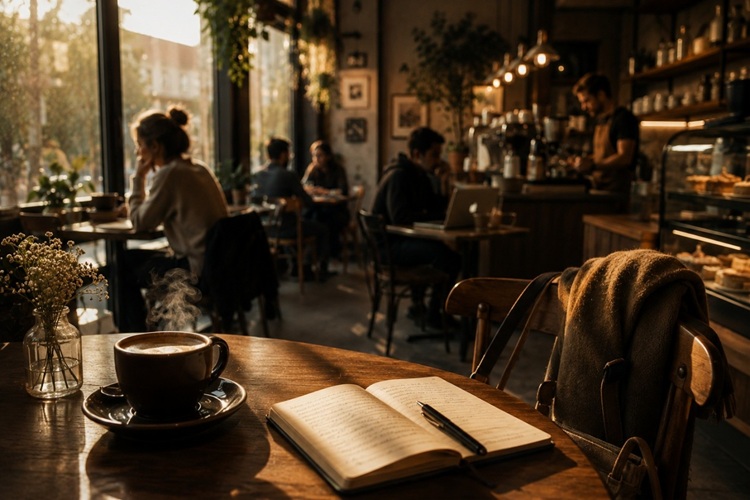
Perhaps it’s the barista who smiles before you’ve even reached the counter. Maybe it’s the corner seat you’ve unconsciously claimed as your own, or the quiet soundtrack playing in the background while the city rushes outside. Over time, these details become so familiar that you hardly notice them anymore. Yet if one of them disappeared, you almost certainly would.
That’s because the relationship we build with a café has very little to do with habit alone. It has everything to do with recognition. There’s a quiet but important difference between knowing a place and feeling known by it. The first time you visit a café, you remember the space. After enough visits, the space begins to remember you. Your usual order no longer needs explaining. Someone greets you by name. You stop feeling like a customer and start feeling like a regular.
That small shift changes everything.
The best cafés aren’t simply places where transactions happen; they’re places where routines become rituals. They quietly weave themselves into everyday life. Morning coffees become the start of a workday. Saturday breakfasts become family traditions. Business meetings, first dates, long conversations, quiet afternoons with a book—these moments slowly transform an ordinary café into something much more personal. Without ever intending to, we begin attaching memories to the place rather than the product.
This is one of the most fascinating evolutions within hospitality today. Cafés are no longer competing solely on quality or convenience. They are competing on connection. In Saudi Arabia, where café culture has flourished over the past decade, this shift is especially visible. Independent coffee houses and homegrown brands have become creative spaces, neighbourhood meeting points, informal offices and community hubs. People arrive with laptops, sketchbooks, business ideas and conversations that stretch far beyond the last sip of coffee. The café has quietly become what sociologists often call a “third place”—a space that exists somewhere between home and work, where people choose to spend time simply because they enjoy being there.
What’s remarkable is that none of this can be listed on a menu.
No café advertises “familiarity” as today’s special. You can’t order belonging with your cappuccino or ask for an extra serving of comfort. Yet these are often the very reasons people return. Hospitality has always been about more than providing a service. At its best, it creates an environment where people feel comfortable enough to become themselves.
Perhaps that’s why so many successful cafés feel effortlessly welcoming. Their lighting, music, design and coffee all play a role, but they’re supporting characters in a much larger story. The real magic lies in the feeling that, for a little while, you’ve stepped into a place where you don’t have to introduce yourself. Nothing asks anything of you. You simply arrive, settle into your usual seat, and the day begins.
The hospitality industry often talks about customer loyalty as though it can be earned through discounts, reward points or the perfect product. Those things certainly encourage repeat visits, but they rarely explain genuine affection for a place. Loyalty isn’t created the moment someone enjoys a great coffee. It’s created the moment they feel that the café would somehow be different without them—and that they, in turn, would miss it if it disappeared.
Maybe that’s why we keep going back.
Not because another café couldn’t make the same latte.
Not because another bakery couldn’t bake the same croissant.
We return because, somewhere between the first visit and the fiftieth, the café stopped being somewhere we went.
It became somewhere we belonged.
And perhaps that’s the one thing no menu has ever been able to serve.